See Michelle Chen’s Want to Exploit Retail Workers? In San Francisco, It’ll Cost You, in The Nation.
More on San Francisco’s response to zero hours
Reply

See Michelle Chen’s Want to Exploit Retail Workers? In San Francisco, It’ll Cost You, in The Nation.
Continuing the fast food theme (yum): BK in the USA vs. BK in Denmark, fast food work can provide living wages, if the institutional environment is right. Read the report by Liz Alderman and Steven Greenhouse in the New York Times.
The fast food restaraunt is an organizational technology designed to use low cost labor – a restaurant that can operate without any employee who knows how to cook! Continue reading
Two weeks advance notice, or you get paid more.

Image from silentsketcher.deviantart.com, via Fast Food News.
San Francisco is the latest American jurisdiction to find an answer to what are called, here in Britain, “zero hours contracts”. As reported by Claire Zillman in Fortune:
[San Francisco’s Board of Supervisors, which is also the city council of that city+county] voted unanimously on Tuesday [25 November] afternoon in favor of measures aimed at giving retail staffers more predictable schedules and access to extra hours. The ordinances will require businesses to post workers’ schedules at least two weeks in advance. Workers will receive compensation for last-minute schedule changes, “on-call” hours, and instances in which they’re sent home before completing their assigned shifts.

Stephen Gardiner, in his book A Perfect Moral Storm, says that climate change produces moral corruption. The worst effects of carbon pollution are many years to come; responsibility is diffused over hundreds of governments, thousands of corporations, billions of individuals, and many generations; and, we are not well practiced or intellectually equipped for making decisions about problems of this sort. So it is hard not to make up stories, to fool ourselves, to tell ourselves that what we do now doesn’t matter, and carry on as before. That is moral corruption. It leaves us with a good chance that action will not be taken soon enough to avert catastrophe.
Americans voted yesterday for more moral corruption, choosing to boost the power of a party that is wedded to the propositions that we can’t have a good life without plenty of fossil fuels, Continue reading
There is a select group of people who can’t take seriously any sentence with the word “skills” in it because, at an impressionable age, they were exposed to Napoleon Dynamite. ND being a film about a boy who is convinced that a range of fairly worthless skills – from the use of nunchucks to high-performance computer gaming – will impress the girls. Not being a sports fan myself, my reflexive response would be to put football (that is, for any compatriots of mine reading this, soccer) skills in this category: it can be a fun game and maybe you will impress those who you wish to impress (or maybe not), but if we’re talking about the problem of skills in our economy surely we should get serious, and talk about literacy, numeracy, and that sort of thing.
Germany wasn’t doing well in international football competition a decade ago, and to solve this problem it turned to what it does best: training. What Germany has done to improve its football skills in recent years as documented in an excellent article by Stuart Jeffries in the Guardian last May is particularly interesting because is shows how the passion for learning a skill for which the market is small and precarious – the case here is football, but similar cases could be made for many arts and sciences – can be harnessed to ensure the acquisition of general, transferable skills.
There are two reasons to treat football skills as meaningful human capital. Continue reading
Readers of this blog (yes, you are legion … waves to crowd) will know that I think investment in skills can be risky, and that because of this the social insurance framework – how generous are short-term unemployment benefits, and who pays for retraining – has a big effect on what sort of skills people choose to acquire. See old posts for various examples.
Now, you might wonder if this can really be so, in our dynamic information economy, in the case of those bread-and-butter tech skills like programming. If you’re good at that, you should be set for life, no? If you do so wonder, then take a look at this piece by Noam Scheiber on The Brutal Ageism of Tech: highly-skilled Silicon Valley nerds in their thirties sneaking off for botox so it won’t be noticed they’re almost ready for the scrapheap.

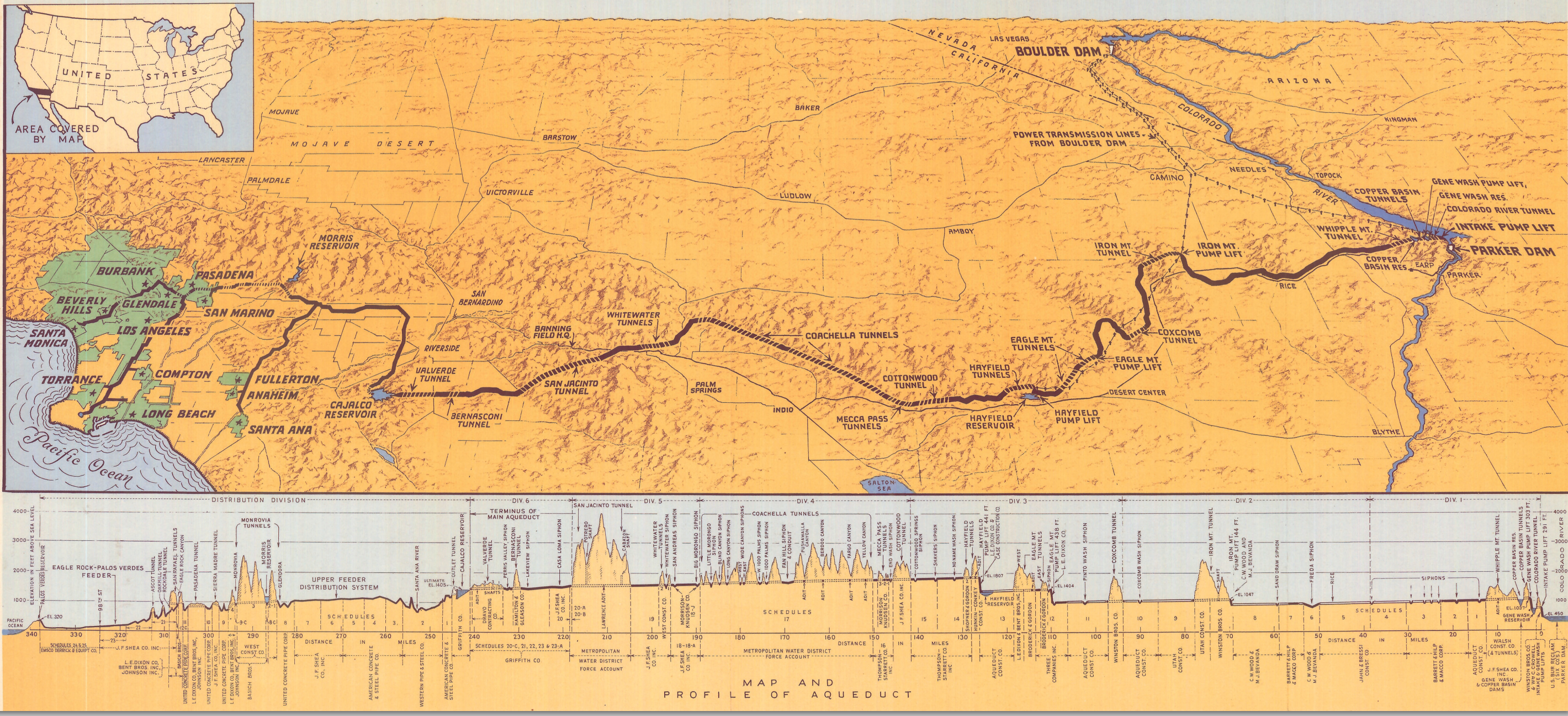
Click image to enlarge; thanks to John Fleck, via Rabett Run, for this beautiful graphic. Of course it reminds you that the city’s water – Chinatown and all that – is coming from desert rivers that don’t flow quite like they used to.
We went to Italy in the first half of August, partly to relax and see friends but mostly because Simona’s father had just died, and Leonardo needed to spend time with his nonna [grandmother]. Just before we went I read about a big mafia bust in Ostia, a town on the sea near Rome. Sicilian mafia families, it seems, pretty much run the streets in Ostia, wringing protection from businesses and controlling the allocation of beach umbrellas, as well as running guns, drugs and prostitutes. Things had been getting out of hand – somebody gunned down in the middle of Ostia, and too much mafia activity was moving into Rome itself – so some arrests were needed.
Simona’s mother was staying not far away, near the beach not far to the south-east of Ostia, north-west of Anzio. Simona and I hung around for a few days while Leonardo and Nonna settled into a new routine, without Nonno. After we paid for dinner one evening at a restaurant by the beach, I observed that Simona had not asked for a receipt, as she would have done in Rome. She’s always told me – I have never actually seen this happen – that the Guardia di Finanza might stop us as we came out of a restaurant and demand to see our receipt, to verify that our payment had been recorded for tax purposes. “There’s no need for a receipt here”, she said, “this is all mafia, all up and down this coast. The police Continue reading

– map from Eric Rodenbeck, writing (and mapping) in Wired. Thanks to Louis Suárez-Potts for the link.
For many, San Francisco’s transition from center of finance, trade and manufacturing to a new role as a suburb of the Silicon Valley (the latter comprising the ex-surburbs to its south), seems wrong – a vibrant, heterogeneous city gentrified, converted into a pretty place for techies to perch. It feels wrong to me, too, but at the same time it says something beautiful to me: Continue reading
Gravity-defying CEO pay is not a payment for talent. It’s not looting by the executives, either. It’s the outcome of principal-agent relationship in a market where new technologies combined with regulatory dereliction have created a lot of winner-take-all situations.
More of that, and a few links, below. But first, what prompts this Continue reading
 Frederick Guy