
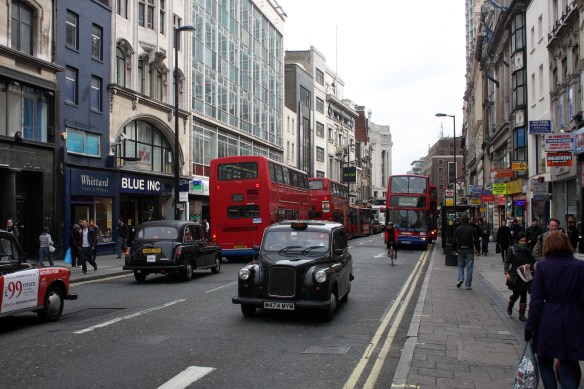
Buses vs. cabs on Oxford Street

london_cabs_and_buses

Sadiq Khan promised during his campaign to pedestrianize Oxford Street. That would mean no buses or taxis (black cabs, which is to say traditional London taxis, not mini-cabs or Uber), which are the vehicles allowed there now.

I’ve been ambivalent about this plan because there are a lot of buses on Oxford Street and it’s not clear how they could be re-routed, yet a pedestrianized Oxford Street would be a terrific improvement for central London.

In November, the first installment of the plan was unveiled in a Transport for London (TFL) consultation. TFL proposed changes to 17 of the bus routes that now use Oxford Street, perhaps this year. They calculate that these changes will require, every weekday, 17,200 riders who now ride through would need to change buses – that is if, with that added inconvenience and delay, those people keep riding buses at all. That represents a serious deterioration in bus service, but it’s not close to taking all the vehicles off Oxford Street, and actual pedestrianization remains a few years off.

One might say, well, baby steps. Yes, you’ve got to start somewhere, but why here? The fact is that a large share of the motor vehicles on Oxford Street are black cabs. Many of these taxis are dead-heading, no passenger, to the City or a train station. As buses thin out on Oxford Street, they are simply replaced by taxis – the road becomes a magnet for ever more taxis, a grand rat run through the West End. And the November consultation is all about reducing the number of buses, saying nothing about taxis. Continue reading
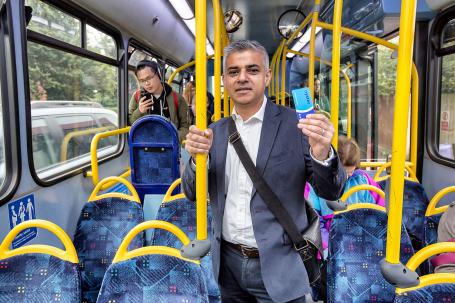
Buses at Bruce Grove: lack of grip?

I am careful not to be too optimistic about the future of cycling on London’s roads, but I did have faith that with Khan as mayor, bus service at least was in safe hands. Now I’m not so sure.

sadiq_khan_1_0

Continue reading

For greener Green Lanes: radical traffic reduction

(Mostly of local interest in a small part of north London)

Until September, there will be no through traffic on Wightman Road.

Many of those who live on Wightman, or on the Ladder roads which normally act as rat-runs between Wightman and Green Lanes, are very happy with the reduction in traffic:

It’s because of a bridge repair, but it raises this question: should it be a temporary measure on just one road, or should Haringey take it as an opportunity to begin seriously to cut through traffic and pollution by private motor vehicles, and a shift to more foot, bicycle and bus travel?
Continue reading

Going Dutch: more about kids than commuters

Percentage of trips by cycling, UK (blue) vs. Netherlands (orange), by age group. From City Cycling, eds. Pucher & Buehler, 2012, via AsEasyAsRidingABike.

update: David Hembrow reminds me of an excellent resource on this – his A view from the cycle path blog, and the linked Campaign for Childhood Freedom.

Two densely populated countries in northwest Europe, with similar mild-if-dreary climates. The difference? Cycle infrastructure. It’s why “going Dutch” has become a motto for cycle advocates in Britain.

Who would benefit from going Dutch? From San Francisco to London (two cities I happen to pay attention to, for personal reasons), public concern about bicycle safety and infrastructure focuses on hardy adults, 18-60, at risk of being hit by motor vehicles – particularly trucks – when commuting. Sometimes we cycle commuters are not the most sympathetic lot, especially when pumped with adrenalin after a near-death experience on the road. For an excellent discussion of why quality cycle infrastructure is not about today’s cycle commuters but the much larger population of potential cyclists – disproportionately children and old people – see this post at AsEasyAsRidingABike. Continue reading

Henry George stalks Islington

Andy Hull, a councilor just down the road from here in the London borough of Islington, is advocating a land tax (thanks, Liberal Conspiracy). This is one of those excellent old ideas that seem to disprove the maxim that inventing a better mousetrap will lead the world to your door – Hull cites Adam Smith, Tom Paine, David Ricardo, John Stuart Mill, Karl Marx, Henry George, David Lloyd George
and Winston Churchill in its favor, yet most places in the world have never had it. For a nice statement of the land tax’s virtues, see this piece by Martin Wolf, three years ago in the Financial Times. Continue reading

Canal towpath as security threat

The Olympics have actually emptied much of London. I cycled in to work yesterday, and it was quiet. Russell Square, between the tube station of the same name and the British Museum, has been made into some sort of Olympic(TM) bus hub, with all the regular bus stops closed. There aren’t many cars about. A student came to see me at 5pm and had to get security to let her in because our building was locked up tight – usually, the front door’s open until 9. All very nice, if you’re riding a bike, though I expect most restaurants in central London will lose quite a bit from this big festival.
Continue reading