Two months ago, Harry Brighouse posted his marvelous Teaching’s not exactly brain surgery, is it? on the Crooked Timber blog. It’s a good thing Brighouse did so right then, because he was playing off of the exalted status we accord brain surgeons, which as we know one American brain surgeon has in the weeks since single-handedly left in tatters. And though we know that, it’s always worth seeing the Guardian’s Marina Hyde pile on in her inimitable style.
Historical details

Check out Ann D. Gordon’s great blog, “Historical Details, It’s All in the“: wonderful stories which draw on her archivally deep knowledge of the lives and times of Susan B. Anthony and Elizabeth Cady Stanton.
We’re not denialists, but please no gloom and doom

I was talking earlier today with a colleague who runs a masters degree on Climate Change Management. Their enrollments have fallen. She attributes this to a “change in the discourse on climate change”, which has rendered the very term a downer, to be avoided (she and her colleagues had thought the degree’s name was pretty upbeat, because “management” suggested… hey, it’s a problem, but we can manage it: not enough, it seems). She contrasted the public attention to the Copenhagen meetings a few years ago, to the relative silence on Paris today. And this of course comes in the midst of an increasingly clear picture of the disaster we’re walking into. If your attention has been elsewhere of late, consider these tidbits:
Kevin Anderson tells us that all the IPCC scenarios that offer at least a 50% chance of staying below 2 degrees depend either on negative emissions technologies that don’t exist yet, or on emissions peaking by 2010 (hint: that didn’t happen). It’s a short and readable piece in Nature Geoscience. Continue reading
I’ll go and help too, vicariously
The joys of teaching at Birkbeck occasionally include emails from students like this
Hi Fred,
I’ve just accepted a 12 month contract to work in Sierra Leone as operations manager for [redacted]. Their focus is to improve the resilience of the Sierra Leone health service post ebola. Started induction in their London office today, will fly out to Sierra Leone 1st July.
I’m still planning to complete my dissertation for first week in September, though would be grateful if we could skype for meetings!
Best wishes
S
Sent from Samsung Mobile on O2
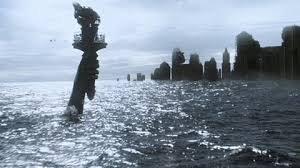
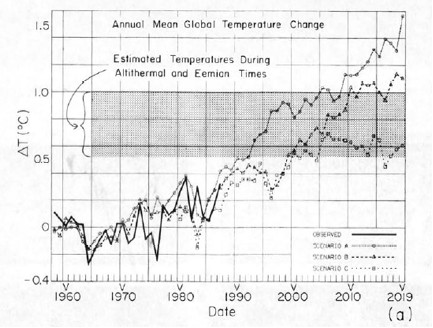
Hansen: even 2 degrees sinks coastal cities

Politicians in Paris will try, if that’s not too kind a word, to find an agreement that will hold down temperature increases to 2 degrees C above pre-industrial levels [+2C].
Still too much, says James Hansen, of NASA (retired) and Columbia University, who has been warning us about this since 1981 or so:
• The last time Earth was +2C, 120,000 years ago, sea levels were 6-8 meters higher than today. 2 degrees would lock that in, the only question being how fast we would get there.
Continue reading
Ordinary surveillance, inequality, and fear
Our friends Giorgio and Gemma, visiting here from Rome, had this impression from a recent trip to New York: workers in New York are scared. Security staff enforced seemingly trivial rules – don’t step across this line – in a way that they couldn’t explain otherwise.
Workers watch you so nervously when they themselves are watched closely and their jobs are insecure. Continue reading
More on San Francisco’s response to zero hours
See Michelle Chen’s Want to Exploit Retail Workers? In San Francisco, It’ll Cost You, in The Nation.
Fast food ≠ low pay
Continuing the fast food theme (yum): BK in the USA vs. BK in Denmark, fast food work can provide living wages, if the institutional environment is right. Read the report by Liz Alderman and Steven Greenhouse in the New York Times.
The fast food restaraunt is an organizational technology designed to use low cost labor – a restaurant that can operate without any employee who knows how to cook! Continue reading
San Francisco escaping zero (hours)
Two weeks advance notice, or you get paid more.
San Francisco is the latest American jurisdiction to find an answer to what are called, here in Britain, “zero hours contracts”. As reported by Claire Zillman in Fortune:
[San Francisco’s Board of Supervisors, which is also the city council of that city+county] voted unanimously on Tuesday [25 November] afternoon in favor of measures aimed at giving retail staffers more predictable schedules and access to extra hours. The ordinances will require businesses to post workers’ schedules at least two weeks in advance. Workers will receive compensation for last-minute schedule changes, “on-call” hours, and instances in which they’re sent home before completing their assigned shifts.
The American elections: a suicide note from human civilization?

Stephen Gardiner, in his book A Perfect Moral Storm, says that climate change produces moral corruption. The worst effects of carbon pollution are many years to come; responsibility is diffused over hundreds of governments, thousands of corporations, billions of individuals, and many generations; and, we are not well practiced or intellectually equipped for making decisions about problems of this sort. So it is hard not to make up stories, to fool ourselves, to tell ourselves that what we do now doesn’t matter, and carry on as before. That is moral corruption. It leaves us with a good chance that action will not be taken soon enough to avert catastrophe.
Americans voted yesterday for more moral corruption, choosing to boost the power of a party that is wedded to the propositions that we can’t have a good life without plenty of fossil fuels, Continue reading