For greener Green Lanes: radical traffic reduction

(Mostly of local interest in a small part of north London)

Until September, there will be no through traffic on Wightman Road.

Many of those who live on Wightman, or on the Ladder roads which normally act as rat-runs between Wightman and Green Lanes, are very happy with the reduction in traffic:

It’s because of a bridge repair, but it raises this question: should it be a temporary measure on just one road, or should Haringey take it as an opportunity to begin seriously to cut through traffic and pollution by private motor vehicles, and a shift to more foot, bicycle and bus travel?
Continue reading


Better cycling infrastructure, or make driving more costly? Yes.

Good cycling infrastructure is extremely important for increasing cycling and for reducing the use of cars in our towns and cities. On main roads, that means protected (segregated) cycle lanes; on side roads it means filtered permeability – pedestrians and cycles go through, cars and trucks don’t. There’s plenty of evidence for the importance of such infrastructure.

But when the UK cycling organization road.cc runs the headline “Cycle infrastructure responsible for 85% of cycling increase“, I have to object. This is the message of Infrastructure, Infrastructure and Infrastructure gone mad. If you read just that headline, you’ll be left with the impression that nothing much matters other than infrastructure. Even if you read the whole article, you won’t know why that interpretation is dead wrong.
Continue reading

We’re not denialists, but please no gloom and doom


I was talking earlier today with a colleague who runs a masters degree on Climate Change Management. Their enrollments have fallen. She attributes this to a “change in the discourse on climate change”, which has rendered the very term a downer, to be avoided (she and her colleagues had thought the degree’s name was pretty upbeat, because “management” suggested… hey, it’s a problem, but we can manage it: not enough, it seems). She contrasted the public attention to the Copenhagen meetings a few years ago, to the relative silence on Paris today. And this of course comes in the midst of an increasingly clear picture of the disaster we’re walking into. If your attention has been elsewhere of late, consider these tidbits:

Kevin Anderson tells us that all the IPCC scenarios that offer at least a 50% chance of staying below 2 degrees depend either on negative emissions technologies that don’t exist yet, or on emissions peaking by 2010 (hint: that didn’t happen). It’s a short and readable piece in Nature Geoscience. Continue reading

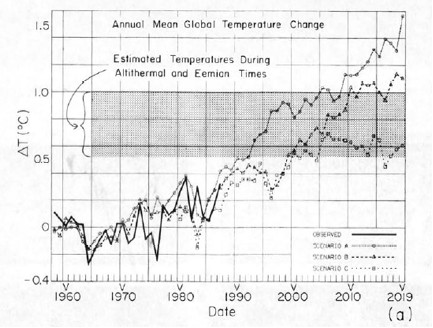
Hansen: even 2 degrees sinks coastal cities

statueoflibertyunderwater
Politicians in Paris will try, if that’s not too kind a word, to find an agreement that will hold down temperature increases to 2 degrees C above pre-industrial levels [+2C].

Still too much, says James Hansen, of NASA (retired) and Columbia University, who has been warning us about this since 1981 or so:

• The last time Earth was +2C, 120,000 years ago, sea levels were 6-8 meters higher than today. 2 degrees would lock that in, the only question being how fast we would get there.
Hansen88Temps Continue reading

The American elections: a suicide note from human civilization?


Stephen Gardiner, in his book A Perfect Moral Storm, says that climate change produces moral corruption. The worst effects of carbon pollution are many years to come; responsibility is diffused over hundreds of governments, thousands of corporations, billions of individuals, and many generations; and, we are not well practiced or intellectually equipped for making decisions about problems of this sort. So it is hard not to make up stories, to fool ourselves, to tell ourselves that what we do now doesn’t matter, and carry on as before. That is moral corruption. It leaves us with a good chance that action will not be taken soon enough to avert catastrophe.

Americans voted yesterday for more moral corruption, choosing to boost the power of a party that is wedded to the propositions that we can’t have a good life without plenty of fossil fuels, Continue reading

Going Dutch: more about kids than commuters

Percentage of trips by cycling, UK (blue) vs. Netherlands (orange), by age group. From City Cycling, eds. Pucher & Buehler, 2012, via AsEasyAsRidingABike.

update: David Hembrow reminds me of an excellent resource on this – his A view from the cycle path blog, and the linked Campaign for Childhood Freedom.

Two densely populated countries in northwest Europe, with similar mild-if-dreary climates. The difference? Cycle infrastructure. It’s why “going Dutch” has become a motto for cycle advocates in Britain.

Who would benefit from going Dutch? From San Francisco to London (two cities I happen to pay attention to, for personal reasons), public concern about bicycle safety and infrastructure focuses on hardy adults, 18-60, at risk of being hit by motor vehicles – particularly trucks – when commuting. Sometimes we cycle commuters are not the most sympathetic lot, especially when pumped with adrenalin after a near-death experience on the road. For an excellent discussion of why quality cycle infrastructure is not about today’s cycle commuters but the much larger population of potential cyclists – disproportionately children and old people – see this post at AsEasyAsRidingABike. Continue reading

Map: corporate shuttle routes from San Francisco to the Silicon Valley

– map from Eric Rodenbeck, writing (and mapping) in Wired. Thanks to Louis Suárez-Potts for the link.

For many, San Francisco’s transition from center of finance, trade and manufacturing to a new role as a suburb of the Silicon Valley (the latter comprising the ex-surburbs to its south), seems wrong – a vibrant, heterogeneous city gentrified, converted into a pretty place for techies to perch. It feels wrong to me, too, but at the same time it says something beautiful to me: Continue reading